
The Rise of Agentic AI: A New Era of Intelligent Automation
Over the past month, a new term has rocketed to the forefront of tech discourse: Agentic AI, also known as autonomous AI agents. Google Trends data confirms it—interest in “AI agents” has not only surpassed “GPT-5” and “multimodal AI,” but is now the dominant topic in developer forums, venture capital pitch decks, and enterprise R&D labs. From early-stage startups to Big Tech giants, everyone is racing to harness the power of autonomous agents.
But what exactly are AI agents, how do they differ from conventional chatbots, and why is the world suddenly so obsessed with them? Let’s dive deep.
What Are Autonomous AI Agents?
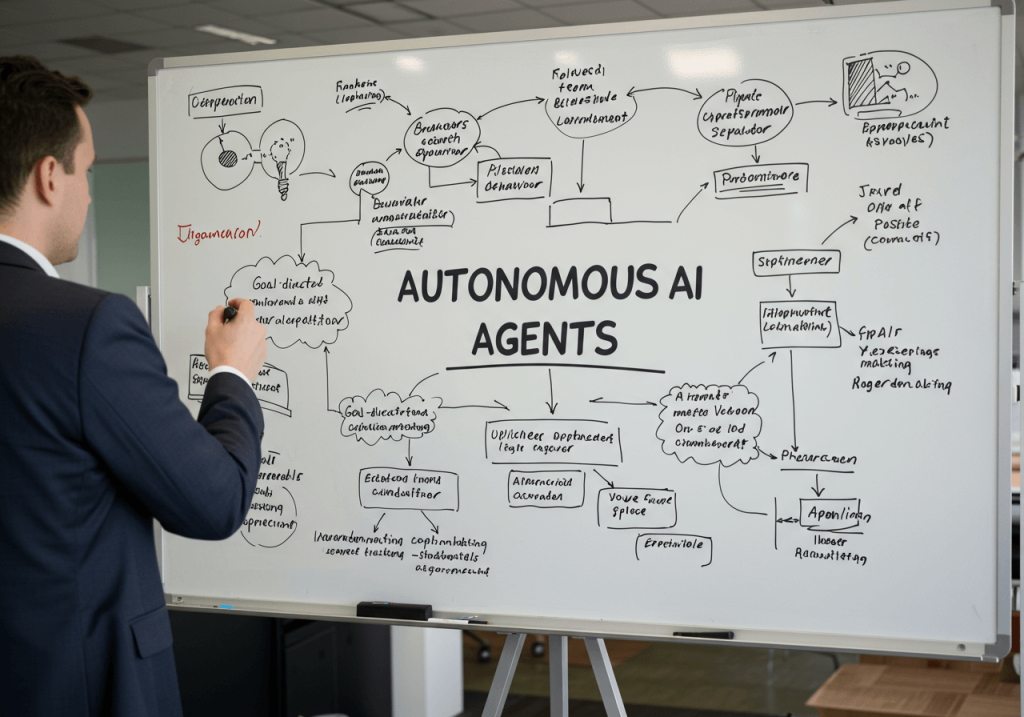
Autonomous AI agents are software entities powered by large language models (LLMs) and other AI technologies that can:
- Plan multi-step workflows
- Make decisions based on context
- Call external APIs or tools
- Take actions with minimal human supervision
They are designed to work independently, unlike traditional chatbots, which are reactive and require continuous user input. Think of an AI agent as a self-directed assistant capable of completing tasks such as analyzing sales data, drafting reports, triaging customer emails, or even managing cloud deployments, from start to finish.
Trending Questions on Google – Answered
1. What is an AI agent vs. a chatbot?
| Feature | Chatbot | AI Agent |
|---|---|---|
| Purpose | Answer specific user queries | Complete multi-step tasks autonomously |
| Initiative | User-driven | Agent-driven |
| Capabilities | Text response generation | Tool use, file manipulation, API calling |
| Intelligence | Reactive | Proactive & adaptive |
Bottom line: A chatbot is a conversational interface; an AI agent is an operational worker.
2. Best Open-Source Agent Frameworks 2025
If you’re diving into building agents, here are the top open-source frameworks gaining traction in 2025:
LangChain: Ideal for chaining LLMs with external APIs and tools.
AutoGen by Microsoft: Multi-agent orchestration at scale.
CrewAI: Great for role-based agent collaboration.
MetaGPT: GitHub favorite for simulating human-like decision-making.
OpenAgents: Lightweight, plug-and-play, supports open toolchains.
3. How to Build an Autonomous AI Agent With LangChain?
LangChain remains a developer favorite for prototyping agents. Here’s a high-level walkthrough:
- Choose Your LLM (e.g., OpenAI, Anthropic, Mistral)
- Define the Tools (e.g., Zapier plugin, browser tool, Python REPL)
- Create a Prompt Template
- Build the Agent Executor (with LangChain’s AgentExecutor class)
- Define Workflow Logic (e.g., ReAct, Plan-and-Execute)
- Launch & Monitor Performance
LangChain’s ecosystem enables a seamless transition from proof of concept to production in just days.
4. AI Agent vs. RPA: Which for Back-Office Automation?
| Feature | AI Agent | RPA (Robotic Process Automation) |
| Flexibility | High | Low |
| Learning Capability | Yes (via LLMs) | No (rule-based) |
| Use Cases | Dynamic, knowledge-heavy tasks | Repetitive, rule-based processes |
| Cost of Maintenance | Lower over time | Higher due to rigid workflows |
Verdict: AI agents are rapidly replacing RPA bots in domains like RevOps, procurement, and finance due to their flexibility and self-learning capabilities.
5. Databricks Agent Factory Pricing
As of June 2025, Databricks’ new Agent Factory module—part of its Mosaic AI suite—offers the following pricing tiers:
- Starter (Free): 1 agent, limited compute, 50 tasks/month
- Pro ($99/month): 5 agents, priority compute, 500 tasks/month
- Enterprise (Custom): Unlimited agents, custom workflows, SLAs
Databricks’ seamless integration with Spark and Delta Lake gives it an edge in data-heavy agent use cases.
What Happened in the Last 10–14 Days? Why It Matters
Major Developments:
- OpenAI released “AutoGPT 2.0” with a native browser, code interpreter, and memory modules.
- Databricks launched Agent Factory to power data-driven agents
- LangChain released v0.2, improving multi-agent orchestration
- EU draft legislation added “high-autonomy systems” to its AI Act
These events solidified the ecosystem, increased enterprise confidence, and triggered a new wave of VC interest.
Why Agentic AI Has Eclipsed Other AI Buzzwords
1. Clear Business ROI
Early adopters across customer service, DevSecOps, and marketing report productivity gains of 30–45%.
“Our support ticket triage time dropped by 70% after deploying an AI agent,” reports a RevOps leader at a Fortune 500 SaaS firm.
2. Low Barrier to Entry
No-code tools like Reka Studio and LangFlow let non-engineers prototype agents with drag-and-drop interfaces.
3. Narrative Shift
After years of focusing on prompt tuning, the new narrative is about end-to-end automation. Enterprises no longer just want clever responses—they want results.
4. VC Spotlight
Top funds now highlight “Agent Operating Systems” in memos. Notable raises in the last 2 weeks:
ReverieOS: $40M Series A
CrewAI: $25M Seed
OrbitalMind: $12M pre-seed
5. Regulatory Momentum
The EU AI Act and US Senate Hearings are now spotlighting autonomous agents. This regulatory clarity is increasing search interest, enterprise readiness, and academic research.
Use Cases in 2025: Where Agents Are Already Winning
- Customer Support: End-to-end ticket triage, response drafting, and sentiment-based escalation
- Sales Enablement: Generating tailored pitch decks, analyzing CRM data, and enriching leads
- DevOps/DevSecOps: Log monitoring, alert triage, infrastructure scaling recommendations
- Finance Ops: Invoice matching, budget analysis, procurement workflow optimization
- Healthcare Admin: Insurance pre-authorization workflows, documentation summarization
What’s Next?
Expect:
- Multi-agent systems coordinating complex operations (e.g., marketing + legal + compliance)
- Standardized agent interfaces like AgentAPI, similar to REST for web services
- Federated agent networks for privacy-first workflows
The era of intelligent software workers has arrived, and it’s rewriting what’s possible in AI automation.
Conclusion
Agentic AI is more than a trend—it’s a paradigm shift. As tools mature, barriers drop, and ROI becomes impossible to ignore, the autonomous agent movement is poised to become the defining force in enterprise AI. Whether you’re a developer, executive, or policymaker, the time to pay attention is now.